
Helpful metaphors for collective scientific grounding

Lately Science, particularly physics, is in a bit of a kerfuffle. People have been asking ‘nasty’ questions like:
‘what have you (physicists) done for us lately?’
and
‘why are we still paying for CERN?’
At the same time, the general public’s interest in natural science is substantial and at the core of their questions - We want to know more about how the world works, in detail, and with minimal fudge factors and handwaving. (or at least some honesty when this is the case)
Space exploration casts a substantial shadow in the popular consciousness, so too the peculiarities of astronomy theories (dark energy, dark matter, black holes, big bangs, etc.) It is natural to ask “how much of this is for realsies?” This is particularly relevant given a recent tolerance for fun but useless “marvel physics” (multiverses come to mind in particular) in the popular discourse perhaps led by similar tendencies from science proper.
Prior to even trying to talk turkey about the details of any particular scientific theory, common ground has to be established regarding what needs to be taken seriously and what can be dismissed or ignored. (insert future article here)
Perhaps even before that it is worth a little commentary about the practice of science using a couple of metaphors:
-The Blind Men and the Elephant
-The “Ocean” of Natural Phenomena and Science
These two metaphorical frames, when combined with a touch of born secrecy, help to explain my perspective around what would otherwise seem a bit absurd, and yes, UFOs can factor into the picture but don’t NEED to:
-Blind Divers and the Huge Manatee’s Treasure
The Blind Men and the Elephant
I won’t insult your intelligence by repeating the details here, but the use of this metaphor in a scientific context is particularly apt, especially when considering those things invisible to unaided senses and inferred from measurements.
The electron was like a particular elephant - We knew electrons as ‘cathode rays’ in the early devices that eventually led to CRT televisions, as beta emissions in the context of radioisotopes. Prior to that we had the ‘magical’ behavior of amber and its static charging, which eventually provided the particle name (via Stoney, a largely ignored ‘quantizer’ prior to Planck).
Each of these contexts provides a different piece of the electron elephant, and prior to a realization (generally attributed to JJ Thompson) that these were a single phenomenon - THE BLIND MEN DIDNT EVEN KNOW THERE WAS AN ELEPHANT. You just had separate people ‘feeling the elephant’ in their own area of application. Making up their own words, the cathode ray folks had a particular language that had no obvious relevance to the phenomena observed in radioactivity. Trunk people, tail people, leg people, and ear people all had their own languages and conceptions first.
It is important to notice that the metaphor is never about a single blind man, or anyone having working vision. Historical narratives about scientific progress tend to promote a “progress by genius” model, where certain especially gifted individuals provide the insight to further development. This idea belies the context of any particular discovery / theory, which is always a product of a group effort around issues of experiment design, data collection, analysis and interpretation, replication and validation, etc. The larger scientific milieu of any given person includes general and problem specific principles - elephant parts. In the sense of specific problems, there are many separate groups of blind people around different elephants. In the larger scope of natural philosophy how the world functions - there is only ONE hyper-fractal elephant, and we only learn about it by forming focus(ed) groups who chew on the models and anomalies to produce a coherent synthesis.
Also note that the rest of the town doesn’t care about the elephant in the same way the blind men do, but the blind men were TOLD that there was an elephant in town by some seemingly sighted person, and so their entire elephant fondling activity has been directed by this information. This has deeper implications in terms of the funding and direction of science and the process of deciding what is important enough to look at in the first place. Once you bump into the elephant and start feeling it, it’s natural to look for others around you who are reporting something similar, because you’re blind.
That said, the issue of what constitutes a particular problem elephant or (elephant part) is no longer as clear to the average interested person as it once was. “What is fundamental” can have drastically different answers, depending on who you ask and how.
Are we all feeling the same elephant? Conceptual clutter muddys the waters and creates substantial dissensus but, assuming earnest and honest activity - there is only one elephant. (Claims of local property variance are perhaps a good example of slop tolerated by the mainstream)
In the context of sense making and problem solving, knowing everything about everything (eating the whole elephant at once) is thankfully not required. Indeed, many of our technologies and systems operate using abstractions that we cannot properly account for in perfect detail, and so we need to identify what is relevant in our conceptions and what can be discarded within particular contexts. For example, simple electronics physics (Think Ohm’s Law and other early work) does not require invocation of electrons explicitly to be of practical use, though additional experiments and more complex devices do require them to explain what can be measured (ignoring anomalies) and so we discard them at our own peril. Semiconductor engineering *sometimes* requires crystallographic information - in other cases it can be largely ignored, depending on the particular material and the fidelity of the models used.
Where I sit, the official narratives (as given by someone who claimed to borrow an eyeball once) are that the elephant is both pink AND invisible with wings. This is leading to a bit of rowdiness in both the bazaar and the cathedral. As we are all blind, the color of the elephant and its transparency will requires some clever intellectual arm wrestling to sort out, but the wings might be addressed sooner rather than later by asking a simple question: What theory can be thrown away without any practical ramifications? This is ‘clipping the elephant’s wings’.
The Ocean of Natural Phenomena and Science
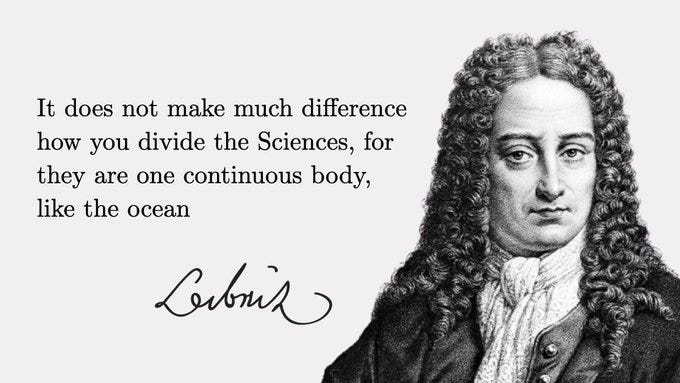
I didn’t realize this was cribbing Leibniz when I wrote this (probably heard it years ago and forgot), but obviously there’s some conceptual overlap in our “science as ocean” metaphors. (It’s a weird post, because I don’t get notifications for comments, and the likes I try to give the replies are routinely ignored/deleted by X. In fact, I’ve just gone and checked AGAIN, and liked all the replies. I’m sure those will be gone when I return to check next time. What service am I paying for again?) Leibniz was talking about an ocean in the context of an encyclopedia and how conceptual information interrelates (like a dictionary), but I think the depth and mysteriousness are relevant.
Exploring the ocean of physics gives a sense of adventure in a way that groping an elephant and muttering to other weirdos does not. Comparing maps to other explorers is a more attractive framing.
The X post that spawned this article identifies 4 types of “Science Ocean” explorer:
A popular science slop merchant is generally a mile wide and an inch deep, on the surface of the sea or more likely the shores. It's all 'comprehendible' but provides nothing to work with. "Everything is vibrations". You feel like you know the ocean because you've sailed the entire surface with them from shore to shore, and there are in fact waves on top. The depths of our ignorance are unprobed by this level of understanding, and those who feel informed by it are perhaps content in not knowing anything about the depths personally- but they still want that treasure! They will repeat stories they hear from people, whether or not they make sense or help find the treasure. Surely if someone finds treasure, they will be loud about the event. More honest popularization outfits would be like fishmongers or a nice seafood restaurant - they tend to get less traffic than the slop merchants but their products is at least actually of the ocean.
While I’m on the subject of honest fishmongery, I would direct attention to SeethePattern, Eugene the Philostopher and DeMystifySci as very solid channels who have helped to bring attention to lesser known theorizing and philosophizing that deserves more consideration. They should probably be a separate group from the slop merchants, but they have a similar role in popularization.
A PhD is like a diver who may have incredible depth of knowledge, but the breadth of that is often relatively narrow. Perhaps they're a foot wide, and a furlong deep. You have to go down a rabbit hole of sorts to assess what's being argued in the first place - everything is a deep dive and you better have equipment to go down there too. Some of them even hit bottom and can tell you what they saw and perhaps why - these statements are mostly incomprehensible to those who have never gone underwater once or twice at least. Some might even think they have found the treasure, but finding consensus on such a thing is a tricky affair for another post as *some* of them are con artists, or driven mad by the bends from the diving process, and report nonsense, or false things, or they just make mistakes - so the proof of the treasure is never in their hands.
A trained engineer or long-practiced technician, are the fishermen and oyster *divers* who work the waters of this ocean who would have some substantial depth in their area of work and some breadth due to applying it in a number of areas. They aren't TRYING to find the depths, or the bottom, they're trying not to have their ships crash, or anything else gruesome happen while they're doing ocean-related activities. They have seen some hints of monsters, and some of them have even been on or adjacent to secret, government funded treasure hunting projects. Unfortunately, many of the best are now getting old, and it's not clear who is listening to their stories anymore.
Anyone building measurement systems of some type (think X-ray CT, TEM/SEM, beamline work, etc.) is in this group FOR SURE. Makers of plasma systems, radiation detectors, antenna arrays, etc.
An internet schitzo-autsavant who smells treasure. They attempt to find the treasure and may report back, but they're sort of like UAV drones wandering in the deep who can't actually locate themselves when underwater with respect to those above. When they resurface, they are like most anyone else paying attention, convinced that the treasure exists and that they saw it, but there's a lot of buzzing, static, repetition of deep sea creature sightings, and other stuff that isn't treasure related which clutters their report. Dismissing this as crazy perhaps isn't fair. There's a reason why PKD is so compelling despite clearly being on the verge of madness. Cantor-esque. The Ocean is deep, and many have died or gone mad exploring it, even before knowing about the treasure. This is also a catch-all category for interested amateurs and opinionated full-time cranks. (to distinguish from mere casual crankiness). I admit this is a mostly fruitless group, but I engage with these people in the same way that an intelligence agency listens to walk-ins. You just never know.
A secret fifth type is the Black Nuclear Submarine Leviathan. It’s down underwater, almost never rises to the surface aside from an occasional bubble, and it’s mapping and collecting its own data. Part biological and part cybernetic, it was commissioned in 1947 after years of construction and nobody knows exactly what it knows, as classified labs/journals/conferences/etc. are not subject to public disclosure generally speaking. That said, you can occasionally get glimpses. It maintains the “secret science security system” or ssss.
For anyone looking to understand and become more enthused by scientific activity (land lubbers), it’s a tricky path. If they don’t go through the initiation process of earning some degree(s), they will likely be tossed into group 4 simply because they will struggle to communicate coherently with others. They’re like the slightly mad PhDivers who we tend to be a bit gracious with because they’re being *slightly* tormented. What we really need to be listening to are more of group 3. What anomalies do they know of? Where do their models break down? These are where the practical problems and limits of our applications lie.
I don’t think this is an exhaustive breakdown, and one could ask something like “where are the professors?”, but if you think there is anything left to be found in science, and especially if you suspect that innovative energy sources and propulsion systems are possible - there are still reasons to go diving for treasure.
When it comes to those trying to approach the ocean, there are various scales in that regard too:
Working back from diving like the Ph.Ds (and candidates), we have swimmers. All of the technical folks in group 3 are swimmy folk, but anyone doing something hands-on that uses some deeper model (like say, making your own cloud chamber at home to visualize radioactivity) is doing some swimming.
If you’re not swimming you are perhaps treading water, or you have floaty devices on your arms. This is the starting point for anyone who walks past the shallow shores. Floaty devices are a more modern creation of the cathedral of physics, but they are things which will hinder diving activity. You might be able to swim with them on, depending on the particulars, but they’re going to hinder diving.
Removal of sophonic floatation devices will be discussed in a future screed.
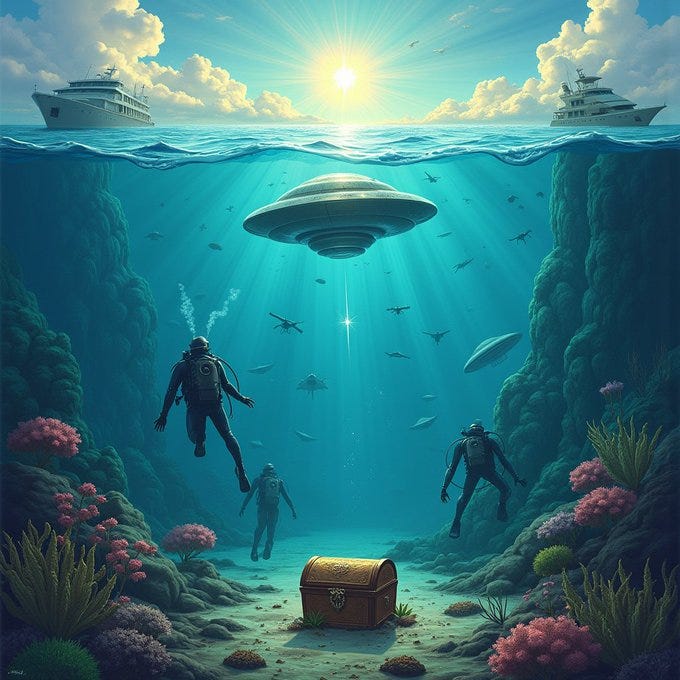
Blind Divers and the Treasures of Huge Manatee
To blend the metaphors, perhaps unnecessarily, we have to talk about the Sub.
The secret science security system submarine, if you will. Elephant fondling was an earnest activity for much of history, but the Manhattan project and subsequent system of clearances served to sever public science from well funded government research which would otherwise be open to the public.
The mere existence of this secret science security system (S^4?) in another country or historical context might not mean as much, but coupled with US dominance in the post war era, the relationship between the S^4 and public science funding mechanisms has substantial impact on the consensus generating process and the collective understanding of what matters - what should (treasure) and should not (arm floatys) be taken seriously. The S^4 Submarine exists. Whether or not it has found ‘all the treasure’ (loosely defined), it has no desire for adversaries to find more treasure than they can find, and if you look into the historical record it’s easy to argue that the majority (if not totality) of post-war scientists who were considered suitably informed to set the research agenda were also holding security clearances of some flavor, Q or otherwise (aka ‘badged’). Also factor in the compartmentalization of the Sub - treasures discovered may be cordoned off within, in case one section becomes ‘depressurized’ and publicly available.
For ‘security reasons’ (both real and fictitious) the sub folks decided that the elephant needed to be relocated - under the sea. Too many blind men from places we don’t trust and occasionally bomb (and perhaps even some allied but not badged places) still wanted to talk about the elephant, some of which had already been dragged underwater before 1947. The process of relocating the elephant took some time, as the old blind men had to die off. New blind men were trained to dive and given badges to fill the sub, but these other guys were getting in the way. By the mid 1970s, most of the old blind men were dead or retired and ignored, and the standard model of physics was ‘entrenched’. The sub could start filling floatation devices painted like treasure or elephant trunks for people to wear on the surface, and many happily put those little things on in accepting certain ideas at face value.
For an honest US citizen who simply wants to better understand how nature operates, it’s not clear how Sub will respond to explorations. It has been said that “the nature of reality is not government property” - but they certainly own their own data.
We know that they release their own bubbles, and if Phillip J Corso is to be believed, quite a few technologies were spun out into the public domain - not everyone on the Sub is a jerk necessarily.
More to be said…
Summary of the Summary
The official story about the elephant of ‘how matter works’ is that it is both pink and invisible, with wings, though some common sense features (ears, trunk, tail, legs) are included for historical reasons if nothing else. It has been relocated underwater for security purposes, perhaps indefinitely. The trunk is above water still, allowing it to breathe, but it’s not so easy to find these days with all the floaty devices.